
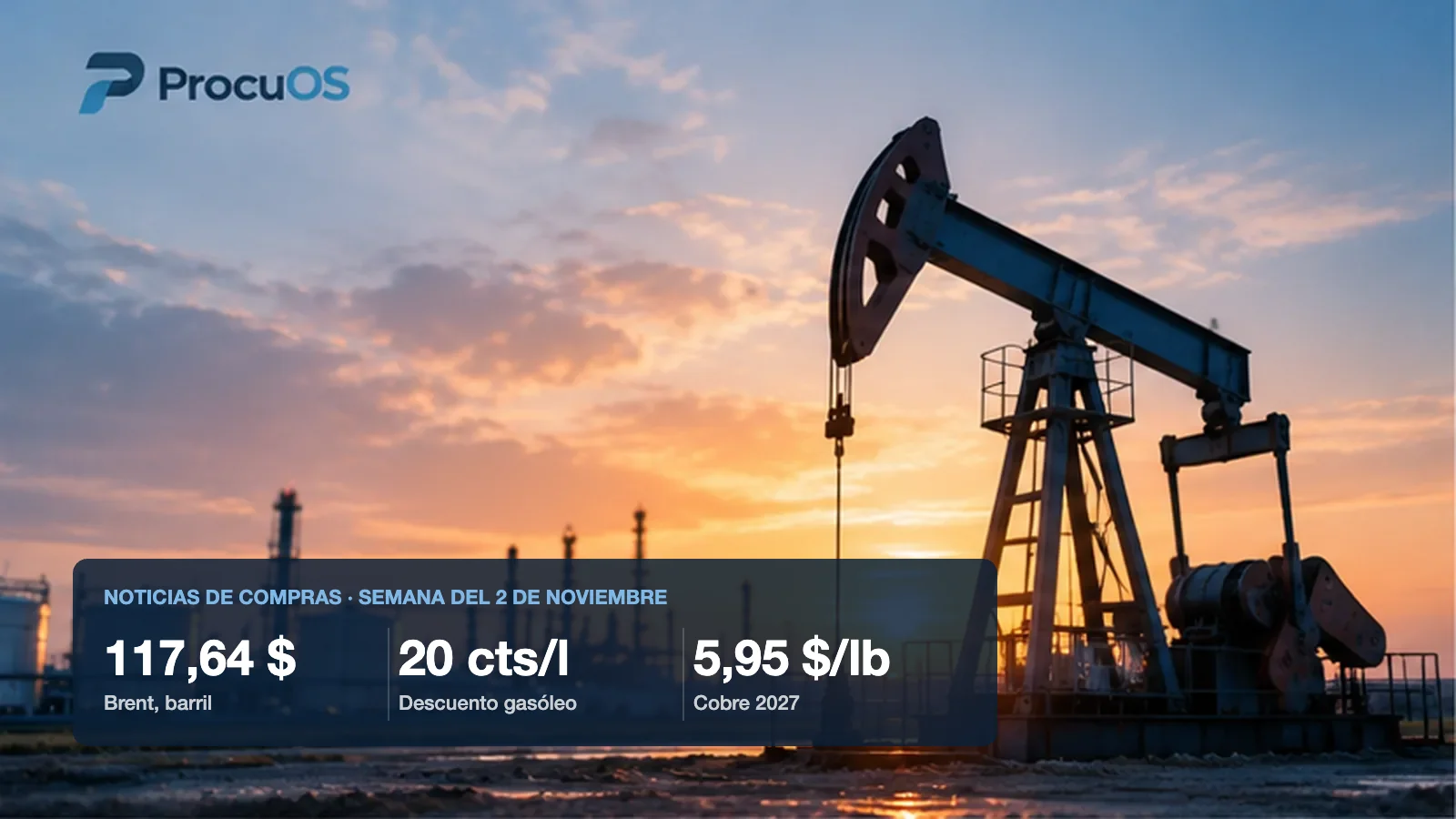
Oil closed October at its highest level since May and energy is still setting the agenda. In Spain, inflation is stuck at 4.9% and the fuel tax discount stays in place in November. In Europe, the ECB is waiting until December. In Latin America, Chile, Colombia and Peru are bracing for more inflation, and Mexico is still waiting for relief on US tariffs.
The week in 8 numbers
| Indicator | Figure | Trend | Where you’ll feel it |
|---|---|---|---|
| Brent crude | US$117.64/barrel (30 Oct) | ▲ +13% in October | Transport, plastics, chemicals, packaging |
| Diesel (Spain, average) | €1.887/litre | = (−0.1%) | Road freight fuel surcharges |
| Shanghai–Rotterdam freight (40 ft) | US$3,686 | ▲ +1% | Imports from Asia (Genoa, flat at US$4,151) |
| Spain CPI (October, flash) | 4.9% · core 3.1% | = | Renewals of CPI-linked contracts |
| ECB rates (deposit) | 2.50% | = (next meeting 17 Dec) | Cost of financing stock and payment terms |
| Copper (weekly close) | US$6.55/lb | ▲ +0.24% | Electrical material, cables, motors, HVAC |
| US dollar / Mexican peso | 18.79 pesos (30 Oct) | ▲ dollar +0.66% on the week | Dollar purchases from Mexico |
| Lima inflation (October) | 5.25% | ▲ (4.5% in September) | Supplier price reviews in Peru |
Data from the sources listed at the end of the article.
1. Brent closes October at US$117 and OPEC+ keeps the taps shut
What happened. Brent crude ended Friday 30 October at US$117.64, its highest close since early May, and is up more than 13% in October, the fourth straight monthly gain. Behind it: an attack on a tanker in the Strait of Hormuz and fears of an escalation between the US and Iran. On Sunday 1 November, the seven OPEC+ countries that manage the voluntary cuts decided not to change their output for December. The full group meets again on 29 November to set 2027 quotas.
Why it matters to you: there is no relief in sight before December: plastics, chemicals, packaging and transport will keep asking for increases. Before accepting any, ask for it to be tied to a public index (for example, the monthly average Brent price) with a formula that works upwards and downwards. And don’t lock in 12-month fixed prices at the peak.
2. Asia–Europe freight stable and more ships through Suez
What happened. Drewry’s index of 29 October puts a 40-ft container Shanghai–Rotterdam at US$3,686 (+1%) and Shanghai–Genoa at US$4,151 (unchanged). 62 container ships went through Suez last week, the highest figure of the year. Carriers are announcing increases for November, but Drewry expects stability on Asia–Europe.
Why it matters to you: if your forwarder passes on November’s “general” increases, ask for the reference index: the market is not confirming them. With more ships using Suez the voyage is shorter, so renegotiate lead times too on your orders from Asia.
3. The ECB waits until December, and Lagarde announces she is leaving
What happened. On Thursday 29 October, the ECB held the deposit rate at 2.50%, although it warned that expensive energy is a risk for inflation. Lagarde said that, barring a major event, “the direction we are going to take is clear to everyone”, which the market reads as a possible hike on 17 December. She also announced she will leave the bank on 7 February 2027, almost nine months before the end of her term.
Why it matters to you: if rates go up, your suppliers will want to be paid sooner. Don’t give away payment days for free: if they ask to move from 60 to 30 days, it should come with an early-payment discount.
4. Inflation stays at 4.9% and the economy loses steam
What happened. According to the INE flash estimate of Friday 30 October, October CPI is up 4.9%, the same as in September, with core inflation (excluding energy and fresh food) at 3.1%. The same day, the INE reported that GDP grew 0.6% in the third quarter, one tenth less than in the previous one, with consumption and investment slowing.
Why it matters to you: the gap between 4.9% and 3.1% is worth money in every renewal. If the product isn’t energy-intensive, negotiate on core inflation. With demand cooling, some suppliers have spare capacity: a good time to ask for alternative quotes.
5. The 20-cent fuel discount stays in place in November
What happened. The cut in the hydrocarbon tax was due to fall from 20 to 13 cents per litre on 1 November, but it stays at 20 cents because diesel prices rose 34% year on year in September, above the 15% threshold set by Royal Decree-law 25/2026. In December it will be 13 or 20 cents, depending on each fuel’s October CPI. In addition, until 31 December, hauliers that don’t use professional diesel can apply for direct aid per vehicle.
Why it matters to you: in November diesel does not go up because of taxes, so there is no reason to raise the fuel surcharge this month. And ask your haulier whether they will apply for the direct aid: it’s a saving they should share with you.
6. Chile holds rates and warns of more inflation; copper will stay expensive
What happened. On Tuesday 27 October, the Central Bank of Chile held its rate at 4.5% unanimously and warned that risks to inflation “have increased significantly”. Inflation was 4.1% in September. On Friday 30 October, Cochilco raised its 2026 copper price forecast to US$6.18 per pound (previously 5.95) and its 2027 forecast to US$5.95 (previously 5.10), because mine output is not keeping up with demand.
Why it matters to you: the 2027 forecast rises 17%, so don’t expect copper to fall next year. If you buy cable, electrical material or HVAC, split the price into metal (linked to the market price) and manufacturing (fixed) and close 2027 with that formula. In Chile, review contracts indexed to UF or CPI now.
7. Colombia one vote away from a hike; Peru with its highest inflation in three years
What happened. Colombia’s Banco de la República held its rate on Friday 30 October at 12.25% by four votes to three: three members wanted a 0.25-point hike. Inflation was 6.3% in September. In Peru, Lima inflation reached 5.25%in October, the highest in 38 months, driven by fuel and transport. The Central Reserve Bank’s rate remains at 4.25%.
Why it matters to you: with credit at 12.25% in Colombia, suppliers will ask to be paid sooner or raise prices to finance their stock. Have a plan B for critical suppliers. In Peru, expect increase requests “because of transport”: insist they are limited to the logistics part of the cost, using actual INEI data.
8. Mexico: relief on US tariffs is unlikely to arrive this year
What happened. A former US trade negotiator sees it as “unlikely” that Washington will lift the Section 232 tariffs on Mexican steel, aluminium and cars before year-end, and believes USMCA may lose priority after the midterm elections. The underlying issues (rules of origin, labour matters, IMMEX) would be left for 2027. The dollar closed Friday at 18.79 pesos, 0.66% more expensive than a week earlier.
Why it matters to you: if you export to the US or buy steel or aluminium, budget 2027 with current tariffs, not with a reduction. If you operate under IMMEX, ask your suppliers to document the origin of their components now: it will be the first thing to be reviewed. For dollar purchases, agree an exchange-rate band.
What to do this week: procurement checklist
- Reject fuel surcharge increases in November (Spain).
- In CPI-linked renewals, propose core inflation (3.1%) if energy weighs little in the product.
- No 12-month fixed prices on energy and derivatives before 29 November: a quarterly review with an up-and-down formula is better.
- Separate metal and manufacturing in your 2027 copper contracts (all regions).
- Don’t give away payment days without a discount in return (Spain and Colombia).
- Budget 2027 with current US tariffs and ask for origin documentation (Mexico).
Worked example: what is a fuel surcharge really worth?
Your haulier asks for 5% more in December because “the diesel discount is going down”. Take a 1,000 km trip that costs you €1,400, with a truck that uses 32 litres per 100 km.
Fuel per trip: 1,000 km × 32 / 100 = 320 litres. If the discount falls from 20 to 13 cents, each litre goes up by 7 cents: 320 × 0.07 = €22.40 per trip.
€22.40 on €1,400 is 1.6%. 5% would be €70: more than three times what fuel justifies. And if the discount stays at 20 cents, the justified increase is zero.
Difference: €47.60 per trip.
The rule, valid in any country: ask for the litres per trip and calculate the effect yourself.
Dates for your diary
- Monday 9 November: next edition of this roundup.
- Friday 13 November: final October CPI in Spain; it decides December’s fuel discount.
- Sunday 29 November: OPEC+ sets 2027 output.
- Tuesday 15 December: next Central Bank of Chile decision.
- Thursday 17 December: ECB meeting, with a possible rate hike.

Our take
The same idea repeats on both sides of the Atlantic: expensive energy, inflation that won’t come down and credit getting more expensive. Suppliers will ask for increases, many with generic explanations. The difference between accepting 5% and negotiating 1.6% isn’t more haggling, it’s data: which index each contract uses, when it expires, how much energy weighs and what alternatives you have.
You can’t keep track of that in a spreadsheet shared among several people. In ProcuOS we bring contracts, expiry dates and terms together in one place, keep suppliers approved and their information up to date and let you request quotes from several suppliers with an electronic negotiation in a few minutes.
— The ProcuOS team
Request a ProcuOS demoWe’ll show you how to prepare a renegotiation using a real case from your company.
Found it useful? Share it on LinkedIn or forward it to someone on your team.
Sources
- Brent: Infobae, 30/10/2026
- OPEC+: GBM / Reuters, 01/11/2026
- Freight (Drewry WCI): Daily Cargo News, 30/10/2026
- ECB decision: European Central Bank, 29/10/2026
- Lagarde’s statements: Noticias Trabajo, 01/11/2026 and Estrella Digital, 30/10/2026
- Spain CPI and GDP: El Español, 30/10/2026 and Infobae, 30/10/2026
- Fuel discount: Motor.es, 27/10/2026 and Spanish Ministry of Finance, 29/09/2026
- Diesel price (EU Weekly Oil Bulletin): PressDigital, 29/10/2026
- Central Bank of Chile: statement, 27/10/2026 and BioBioChile, 27/10/2026
- Copper: BioBioChile, 30/10/2026 and Cochilco, 30/10/2026
- Banco de la República (Colombia): statement, 30/10/2026 and Infobae, 30/10/2026
- Inflation in Peru: Infobae, 01/11/2026
- USMCA and tariffs: Expansión, 30/10/2026
- Mexican peso: Infobae, 30/10/2026