
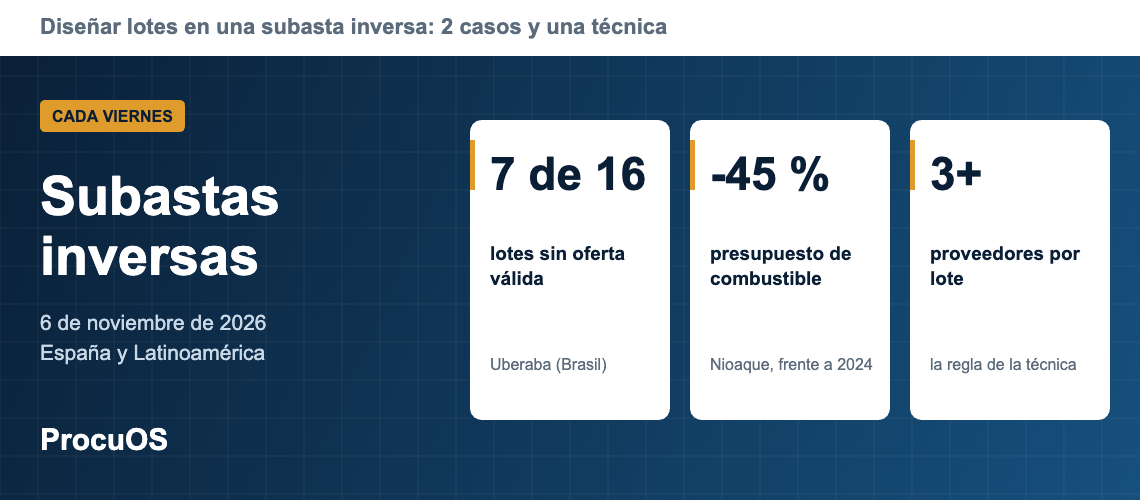
A Brazilian city put 16 lots of furniture and equipment out to reverse auction, and seven of them ended without a single valid bid.
This week we look at two Brazilian public purchases that teach the same lesson from different angles: how you prepare an auction decides its outcome before the first bid. And we turn it into this week’s technique: how to design the lots of a reverse auction.
1. Uberaba (Brazil): 7 of 16 lots not awarded
What happened. The city of Uberaba, in Minas Gerais, closed electronic reverse auction (pregão eletrônico) 071/2026 on 4 November. It was meant to equip a municipal social-services unit with furniture and appliances. According to JM Online, the purchase was split into 16 lots: eight were awarded, seven ended as “failed” and one is still pending an appeal. In Brazil, a failed lot is one that received bids, none of which could be accepted, either on price or on requirements. That is not the same as a deserted lot, where nobody bids at all.
It wasn’t the first attempt. The auction was scheduled for 25 August, was suspended to change the technical specifications and was relaunched with the same budget.
| Figure | Brazilian reais (R$) | Euros | US dollars |
|---|---|---|---|
| Estimated budget (16 lots) | 163,900 | About 26,700 | About 30,000 |
| Amount awarded (8 lots) | 52,182 | About 8,500 | About 9,500 |
Type of figure: reported; published by the local press based on the municipal decision, which we have not been able to check directly. The R$52,182 is not a saving: it only covers the awarded lots, as the newspaper itself points out. Converted at the reference rates of 5 November 2026: €1 ≈ R$6.1355 and €1 ≈ US$1.1224 (ECB); dollar figures calculated by crossing those two rates.
What your company can copy:
- Count the lots that fail, not only the savings on the ones that succeed.
- Talk to the market before closing the specifications. If you have to change requirements after launching, the design wasn’t ready.
- Don’t trust an old budget. If the first call didn’t work, review the reference price too, not just the specifications.
2. Nioaque (Brazil): fuel budgeted 45% cheaper than in 2024
What happened. The city of Nioaque, in Mato Grosso do Sul, has launched electronic reverse auction 027/2026 to buy petrol and diesel for its fleet for twelve months: about 990,895 litres. According to O Pantaneiro (4 November), the estimated value is R$6.99 million, around 45% less than the estimate for the equivalent purchase in August 2024. The auction has not taken place yet.
| Figure | Brazilian reais (R$) | Euros | US dollars |
|---|---|---|---|
| 2024 estimate | 12.8 million | About 2.09 million | About 2.34 million |
| 2026 estimate | 7.0 million | About 1.14 million | About 1.28 million |
| Estimated average price per litre (2026) | 7.06 | About 1.15 | About 1.29 |
Type of figure: reported, and not yet a saving. It compares two budgets, not two awarded prices. The price per litre is our own calculation. The article doesn’t give the 2024 volume, so we can’t tell how much of the drop is price and how much is lower volume. Same exchange rates as in the previous case.
What your company can copy:
- Always compare unit prices. 45% less in total may mean fewer litres, not a better price.
- Update the reference before every auction. Had they used the 2024 budget as the starting price, suppliers would have had a very comfortable ceiling.
- Split by fuel type. Petrol, diesel and S10 diesel have different suppliers and prices: three lots compare better than one big bag.
7 of 16
The Uberaba lots that ended without a valid bid: 44% of the lots (our own calculation). That’s why this week’s technique is about lots.
A lot is what a supplier bids on as a whole. If it’s too large or mixes different things, few suppliers can bid on all of it and competition disappears. If it’s too small, nobody finds it worth preparing a bid and it ends up deserted. The rule of thumb: each lot should group items sold by the same suppliers and be large enough for at least three of them to want to bid.
Example (illustrative figures). A company spends €120,000 (about US$135,000) a year on maintenance supplies: electrical, plumbing, hardware and personal protective equipment. Here are three ways to auction it:
| Design | Lots | Suppliers bidding per lot | Likely outcome |
|---|---|---|---|
| Everything in one lot | 1 of €120,000 (about US$135,000) | 2 (generalists only) | Little pressure: the winner wins on what it knows and adds margin on the rest |
| By item | 40 of about €3,000 (about US$3,400) | 0 to 3, very uneven | Deserted lots, 15 suppliers to manage and freight costs that eat the savings |
| By product family | 4 of €20,000 to €40,000 (about US$22,000 to US$45,000) | 4 to 6 | Real competition in every lot and few suppliers to manage |
Before closing the lots, ask your regular suppliers which families they cover and what minimum volume interests them. And if in doubt, allow bids on one lot or several, but never force suppliers to bid on all lots to win one.
What to report: for each lot, how many suppliers you invited, how many bid and whether it was awarded. If a lot has fewer than three bidders or ends up deserted, the problem is the design, not the market.
And savings, lot by lot: a strong overall result can hide a lot where only one supplier bid and you overpaid.
How to apply it this week: a procurement checklist
- Take your next auction and group its items into families sold by the same suppliers.
- Check that each family has at least three suppliers able to bid on all of it.
- Ask two or three suppliers whether the size of each lot interests them.
- Update the reference price per lot, in unit price.
- Register suppliers in good time and run a test bid before auction day.
Our take
At ProcuOS we believe half of an auction’s result is decided before bidding opens. Uberaba and Nioaque show it: lots nobody can bid on properly and reference prices that need reviewing. Designing lots requires consumption data by item and by supplier, and spreading it across several Excel sheets is the fastest way to lose track. That’s why it pays to prepare a reverse auction on a secure, reliable platform that is easy for suppliers to use, where every lot, every invitation and every bid is recorded.
This is how ProcuOS electronic negotiation works.
Have a good weekend, and may your next auction go out with well-designed lots.
— The ProcuOS team
Was this useful? Share it on LinkedIn or forward it to someone on your team.
Also in English: What happened in procurement this week: oil at US$117, Spain’s diesel discount, the ECB and inflation in Latin America.